


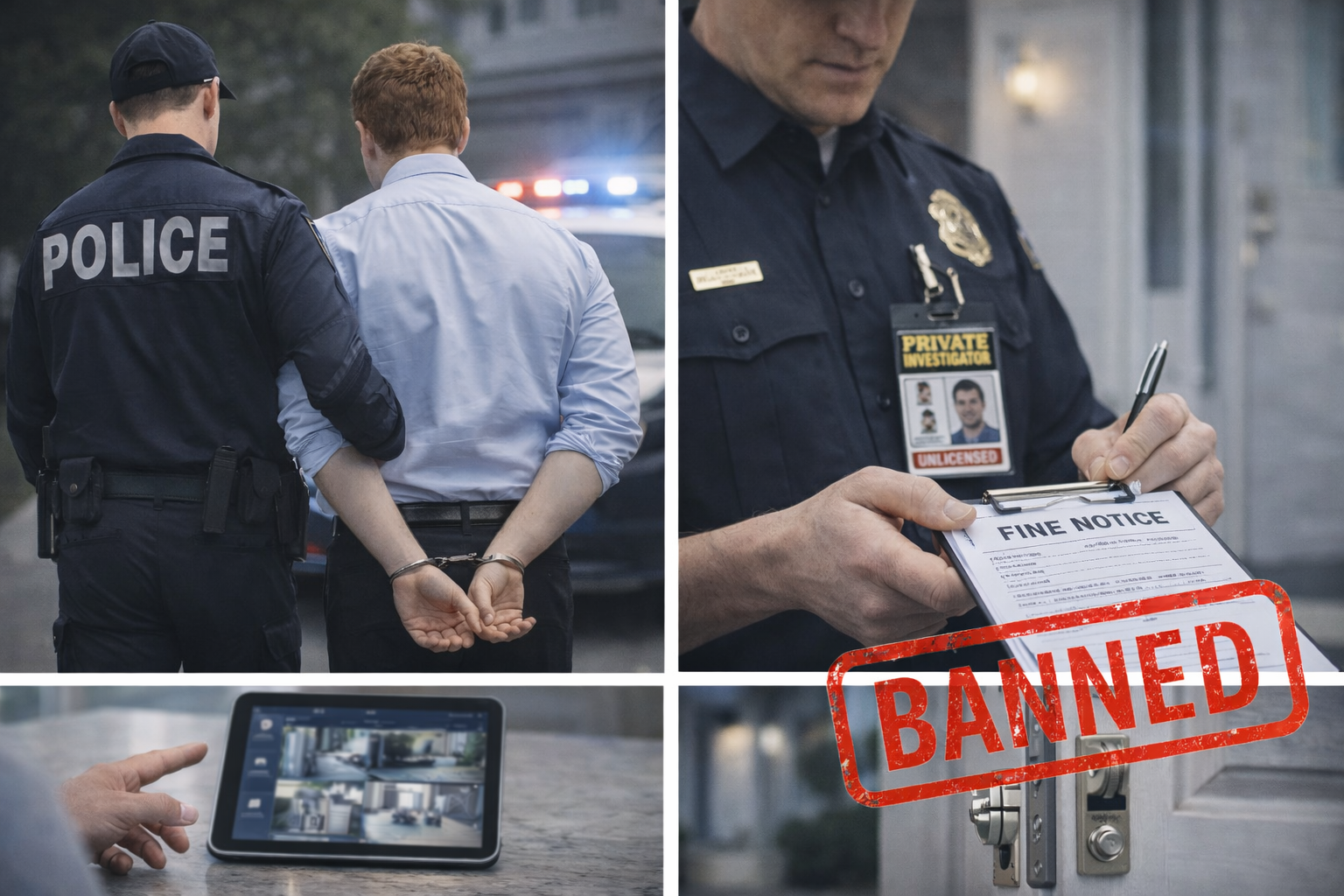
Are you thinking about taking paid surveillance or “investigation” work without a licence? In Australia, private investigator work is regulated at the state and territory level, usually within broader private security licensing schemes. That means the rules (and penalties) change by location, and being “helpful” to a friend doesn’t automatically keep you out of trouble.
Just as importantly, private investigators don’t get special powers that override privacy, trespass, or surveillance device laws. Research on private security consistently notes that private operators generally operate as ordinary citizens under the law, even when they’re doing professional work.
This is general information, not legal advice.
Unlicensed Private Investigator work can lead to fines, criminal charges, and bans
Australia doesn't have one national Private Investigator license. Instead, each state (and the NT) sets its own rules, usually through private security, security industry, or investigations agent laws. In practical terms, that means a job that's legal to perform in one place might be illegal to perform in another without the right license.
Regulators and police can respond in a few ways. They can investigate your conduct, issue court proceedings, and seek penalties for working without a license. In some jurisdictions, the law also targets people who hire unlicensed operators or businesses that "provide" investigation services without proper authorisation. If you run a small agency, that matters.
Just as important, penalties can multiply. Some laws allow charges per job, per act, or even per day you operate. If you followed someone for three days, wrote a report, and billed for it, you might be looking at more than one alleged offence.
Penalty units are another trap for the unwary. A law might say "500 penalty units" rather than a fixed dollar amount. The unit value changes, so the same offence can cost more over time, even if the wording in the Act stays the same.
If you're unlicensed, you're not just risking a fine. You're risking that everything you collect becomes a legal problem.
For anyone considering PI work as a career path, it's safer to start with state-based licensing and supervised roles. This overview of state-specific private investigator licenses in Australia explains how entry-level surveillance, field work, and OSINT fit into compliant practice.
State-by-state snapshot (examples of maximum penalties)
Below are examples taken from the legislation itself (or official regulator pages). Always check the current version for your exact category and situation.
- NSW (Security Industry Act 1997)
A “private investigator” is included as a kind of “security activity” in the Act, and carrying on unauthorised security activities can attract up to 500 penalty units or 2 years imprisonment (or both) for an individual (and higher for corporations).
NSW Police also notes that older CAPI private inquiry agent licensing transitioned to Class 2E (Private Investigator) security licensing. - QLD (Security Providers Act 1993)
Acting as an unlicensed “investigator” can carry a penalty of 200 penalty units or 2 years' imprisonment. - VIC (Private Security Act 2004, authorised version incorporating amendments as at 19 June 2025)
Carrying on certain security activities without the required licence can be 120 penalty units (and business-licensing offences can be higher, including separate “holding out” offences).
Victoria Police confirms major licensing changes commenced from 19 June 2025. - WA (Security and Related Activities (Control) Act 1996, as at 31 March 2025)
WA uses fixed fine amounts in key provisions: acting as an inquiry agent or investigator without the relevant licence carries a $15,000 fine. - TAS (Security and Investigations Agents Act 2002)
You must not undertake “inquiry agent activities” unless licensed; maximum penalties include 1,000 penalty units (body corporate) / 200 penalty units (natural person). - NT (Private Security Act 1995)
A person must not carry out (or advertise/hold out) the functions of a security provider unless they hold the appropriate licence; maximum penalties include 100 penalty units (natural person) / 500 penalty units (body corporate). - SA (Security and Investigation Industry Act 1995)
SA Police states plainly that private investigators must hold a licence, required under the Security and Investigation Industry Act 1995, and SA.gov.au provides the business licence pathway for investigation agents.
Also, licensing fines may stack with other offences if the conduct involved stalking, threats, impersonating police, unlawful access to information, or illegal use of listening or tracking devices.
A risk people miss: you may not be legally entitled to be paid
Even before you get to “fines”, some jurisdictions build in a blunt commercial consequence: unlicensed operators may not be entitled to recover payment for the work.
- Queensland: the Act states a person is not entitled to any reward for functions performed in contravention of the unlicensed-investigator provision.
- Northern Territory: the Act similarly states a person is not entitled to a reward for carrying out the functions if they’re unlicensed.
- Tasmania: the Act includes offences around charging or recovering fees for certain authorised activities unless the person holds the appropriate licence at the time.
In real life, this is where “one quick job” can turn into a refund demand, a billing dispute, and then a regulator complaint.
The lawsuits you could face, and why unlicensed investigations often backfire
Criminal penalties are only half the exposure. Civil claims are about money—and they can be triggered by the same conduct that often shows up in unlicensed “PI jobs”:
- Privacy and surveillance overreach (especially if recordings/tracking are involved)
- Trespass (entering private property to “get the evidence”)
- Defamation (sharing allegations as “facts”)
- Negligence (wrong person, wrong conclusion, real damage)
Australian law reform commentary on private investigators highlights how tightly PI work sits against privacy concerns and “licensing offences”, which is one reason licensing frameworks exist in the first place.
For a realistic view of non-legal risks that still feed into lawsuit exposure (confrontations, bad judgment, and boundary mistakes), see training and licensing for safe PI work in Australia.
Common civil claims: privacy, trespass, defamation, negligence, and harassment
Here's what these claims often mean in plain English:
- Privacy breach: collecting, storing, or sharing sensitive personal data without a lawful basis, for example, forwarding a report with medical or relationship details to the wrong person.
- Trespass: entering private property without permission, even briefly, to "get a better look" or take photos.
- Defamation: publishing or sharing claims that harm someone's reputation, especially if your report states conclusions as facts.
- Negligence: sloppy checks or poor advice that causes loss, for example, misidentifying a person and triggering an unfair workplace allegation.
- Harassment or stalking-type conduct: repeated following, contact, or intimidation, particularly where the subject feels unsafe.
On top of that, surveillance and tracking laws can be strict. Illegal recording or device use can create separate trouble beyond PI licensing.
Client disputes: refunds, breach of contract, and evidence that gets rejected
Many clients hire a Private Investigator to obtain evidence for a family law dispute, a workplace matter, or an insurance issue. If you gather that evidence unlawfully, the client may be stuck paying twice: once for you and again for a licensed investigator to redo the work.
Clients can claim refunds, breach-of-contract damages, or damages if your work can't be used or causes blowback. In some disputes, they may also argue that you misled them about your authority, which can turn a billing dispute into a serious allegation.
Worse still, if your actions cause the other side to incur costs (for example, bringing applications to exclude evidence), a court can sometimes order costs against the party who relied on the material. That can lead to pressure on you, even if you never step into the courtroom.
NSW public examples: what we can confirm from named decisions
It’s true that many Local Court / Magistrates Court matters don’t end up as easily searchable “headline” judgments. But licensing breaches do appear in publicly citable tribunal/case material.
- Ali v Commissioner of Police, NSW Police Service records that Mr Ali was found guilty (no conviction recorded) of knowingly employing an unlicensed person in breach of the licensing framework.
- Sawires v Commissioner of Police includes references to carrying out security activities “while unlicensed” (among other issues).
- Monte v Commissioner of Police, NSW Police Force [2013] NSWADT 139 is publicly listed in tribunal’s annual report case tables (useful to cite existence), even if the decision text isn’t always easy to surface via general databases.
Conclusion
Operating as a Private Investigator in Melbourne or in Australia without a license in Australia can expose you to heavy fines, criminal charges, and long-term licensing damage. On top of that, civil lawsuits are a real risk, especially for privacy, trespass, defamation, or harassment-type conduct. Even when prosecutors don't get involved, a client or subject can still sue for money, and legal fees add up fast.
Check your state or territory rules before accepting any investigative work. If the job involves surveillance, sensitive information, or evidence intended for court, it's not worth doing without a license.
FAQ: unlicensed Private Investigator work in Australia
If I only do one job for a friend, do I still need a license?
Often, yes. If the work fits your state’s definition of investigation services, a "one-off favour" can still count. Payment isn't always the deciding factor, either. Cash, gifts, or "mates rates" can still appear to be providing a service. Advertising and holding yourself out as a Private Investigator can also create issues.
Can I call myself a "consultant" and avoid Private Investigator licensing?
Usually, no. Regulators look at what you actually do, not your label. If you conduct surveillance, find people, gather evidence, or report personal information for a purpose, it may fall within the scope of PI work under local law.
What should I do if I already worked without a license?
Stop taking on new work right away. Don’t destroy notes, messages, invoices, or files, because that can create more trouble. Next, get legal advice and check the rules for the state where the work occurred. Continuing after you realise the risk can increase penalties. Going forward, use a properly licensed provider.
References:
Australian Law Reform Commission. (2010). Private investigators. In For your information: Australian privacy law and practice (ALRC Report 108). Australian Government. Retrieved March 2, 2026, from https://www.alrc.gov.au/publication/for-your-information-australian-privacy-law-and-practice-alrc-report-108/44-new-exemptions-or-exceptions/private-investigators/
Queensland Government. (2025). Penalties and Sentences (Penalty Unit Value) Amendment Regulation 2025. Queensland Legislation. Retrieved March 2, 2026, from https://www.legislation.qld.gov.au/view/html/asmade/sl-2025-0030/lh
Queensland Government. (1993). Security Providers Act 1993. Queensland Legislation. Retrieved March 2, 2026, from https://www.legislation.qld.gov.au/view/html/inforce/current/act-1993-052
New South Wales Government. (1997). Security Industry Act 1997. NSW Legislation. Retrieved March 2, 2026, from https://legislation.nsw.gov.au/view/whole/html/inforce/2023-06-01/act-1997-157
New South Wales Parliament. (2004). Commercial Agents and Private Inquiry Agents Act 2004. NSW Legislation. Retrieved March 2, 2026, from https://legislation.nsw.gov.au/view/html/inforce/current/act-2004-070
NSW Police Force. (n.d.). CAPI licences (SLED). NSW Police Public Site. Retrieved March 2, 2026, from https://www.police.nsw.gov.au/online_services/sled/capi_licences
Victoria State Government. (2025). Private Security Act 2004 (Authorised Version No. 027, incorporating amendments as at 19 June 2025). Victorian Legislation. Retrieved March 2, 2026, from https://content.legislation.vic.gov.au/sites/default/files/2025-06/04-33aa027-authorised.pdf
Victoria Police. (2026). Changes to private security licences and registrations. Retrieved March 2, 2026, from https://www.police.vic.gov.au/changes-private-security-licences-and-registrations
Western Australia Government. (2025). Security and Related Activities (Control) Act 1996 (as at 31 March 2025). WA Legislation. Retrieved March 2, 2026, from https://www.legislation.wa.gov.au/legislation/statutes.nsf/RedirectURL?OpenAgent=&query=mrdoc_48361.pdf
Tasmanian Government. (2023). Security and Investigations Agents Act 2002 (current in-force version). Tasmanian Legislation Online. Retrieved March 2, 2026, from https://www.legislation.tas.gov.au/view/whole/html/inforce/2023-07-01/act-2002-019
Department of Justice (Tasmania). (2025). Legislation (Penalty units). Tasmanian Government. Retrieved March 2, 2026, from https://www.justice.tas.gov.au/about-us/legislation
Northern Territory Government. (1995). Private Security Act 1995. NT Legislation. Retrieved March 2, 2026, from https://legislation.nt.gov.au/api/sitecore/Act/PDF?id=12130
South Australia Police. (n.d.). Private investigators and security guard licences. Retrieved March 2, 2026, from https://www.police.sa.gov.au/services-and-events/licences-and-permits/private-investigators-and-security-guards
Government of South Australia. (2025). Apply for a business investigation agent licence. Retrieved March 2, 2026, from https://www.sa.gov.au/topics/business-and-trade/licensing/security/business-licence/investigation-agent-licence
Sarre, R. (2007). The legal powers of private security: An Australian perspective. QUT Law & Justice Journal, 7(1). Retrieved March 2, 2026, from https://lr.law.qut.edu.au/article/download/45/44/45-1-90-1-10-20120615.pdf
Administrative Decisions Tribunal of NSW. (2013). Administrative Decisions Tribunal Annual Report 2012–13. Retrieved March 2, 2026, from https://ncat.nsw.gov.au/documents/reports/add-annual-report/adt_annual_report_20131.pdf
