



Discovering that a piece of land, a bank account, or an old family heirloom has been left unclaimed can feel like finding a needle in a haystack. Across Australia, billions of dollars in lost shares, unclaimed insurance payouts, and forgotten assets, including abandoned real estate, sit waiting for their rightful owners. This is where property investigation becomes essential. If you’ve ever suspected that you or a relative might have a claim to forgotten property or assets, you aren’t alone, but proving ownership and navigating the legal requirements is rarely simple without professional investigative support.
Whether you’re a legal professional trying to settle an estate or an individual chasing a family legend, the help of a Private Investigator can be the difference between a successful claim and a closed door. These professionals specialise in connecting the dots between modern identity and historical records. From the bustling streets of Sydney to the remote corners of Western Australia, abandoned property investigations require a unique blend of genealogical research, data analysis, and boots on the ground.
Understanding the Scope of Abandoned Assets
What exactly counts as abandoned property in Australia? It’s a broad category that covers more than just derelict houses. Most often, investigations focus on financial assets that have been inactive for a set period, usually 7 years. This includes dormant bank accounts, uncollected life insurance policies, and dividends that never reached the shareholder.
Real estate is a more complex beast. Sometimes land is left behind when a family moves overseas, or an owner passes away without a clear will. Over the decades, these properties have become overgrown and forgotten, yet the title remains in the name of someone from the past. Investigating these cases involves more than just a quick search; it requires a deep dive into land titles and historical registers.
The Role of a Professional Investigator
When you decide to pursue a lead on abandoned property, you might start with a basic search. But what happens when the records are incomplete, or names have changed? This is where a professional’s expertise comes in. A specialised investigator doesn’t just look for a name; they build a comprehensive bridge of evidence to link you to the asset.
One of the primary tools in their arsenal is the factual investigation services used to verify the legitimacy of a claim. They examine the paper trail to ensure every link in the chain of ownership is solid. This prevents legal headaches down the road and provides the documentation required by government authorities to release funds or titles.
Why Locating Heirs and Owners is Difficult

In a perfect world, a quick phone call would solve the mystery. In reality, people move, change their names after marriage, or pass away without leaving a digital footprint. Australia’s vast geography makes it even harder to track someone who might have moved from a gold-mining town in the 1950s to a Melbourne suburb today.
Investigators use sophisticated methods to locate individuals in Australia and track down those with a rightful claim. They don’t just rely on the phone book. They use proprietary databases, historical electoral rolls, and census data to reconstruct family trees. This skip tracing process is essential when an abandoned property investigation involves an owner who has been “missing” from the records for forty years.
The Legal Framework for Investigations
Any investigation into abandoned property must respect the Rule of Law. This is a foundational principle in Australia, ensuring that no power is used arbitrarily. Investigators must operate with fairness and professionalism, especially when handling sensitive personal information. In 2022, the Australian Government Investigations Standard (AGIS) was updated to provide a roadmap for entities conducting such inquiries.
While government-only standards may not strictly bind private firms, reputable investigators choose to align with these high benchmarks. This includes maintaining strict confidentiality and following the Privacy Act 1988. If an investigator oversteps by infringing on privacy rights, they risk invalidating the entire claim.
Steps in a Property Investigation
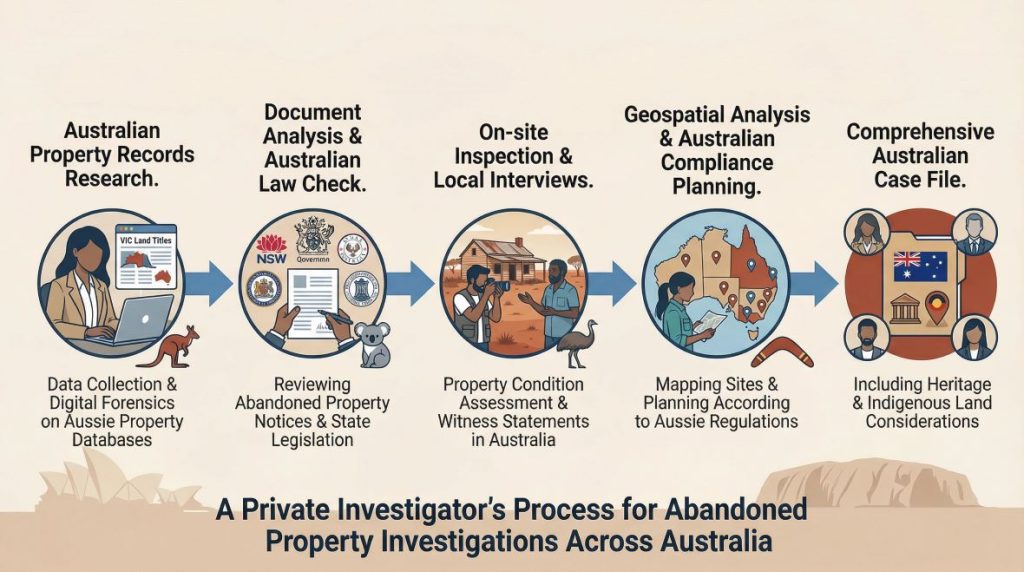
A typical abandoned property search follows a structured path to ensure no detail is missed. It begins with an initial assessment of the available information. Is there a specific address, a bank name, or just a family story? From there, the investigator moves through several phases:
- Database Scrutiny: Searching through land titles, company registers, and deceased estate notices.
- Genealogical Mapping: Building a family tree to prove the line of succession for the property.
- Field Research: Visiting physical locations to check the status of land or interviewing neighbours who might remember previous occupants.
- Evidence Compilation: Gathering birth, death, and marriage certificates to create a trial-ready brief of evidence.
This methodical approach ensures that by the time you’re ready to make a formal claim, there’s no doubt about your entitlement.
High Standards and Accountability
Ethics are the bedrock of any serious investigation. Investigators are often in a privileged position with access to private records. They must make defensible decisions that can withstand the scrutiny of a court or a government ombudsman. If an error occurs, such as mistaken identity, it can lead to significant delays or even legal liability.
You should look for professionals who emphasise transparency. A good firm will have clear procedures for handling exhibits and evidence, ensuring that all collected items are admissible in legal proceedings. This level of care protects you from the risk of your claim being rejected due to poor record-keeping or procedural errors.
The Impact of Technology on Searches
The days of only looking through dusty ledger books are gone. Modern investigations use advanced data analytics to find connections that aren’t obvious to the naked eye. Digital records for land titles across various Australian states are now more accessible, but they still require a trained hand to interpret.
However, technology isn’t a magic wand. Sometimes the most vital piece of a puzzle is found in a physical archives office or through a conversation with a distant relative who still lives in the same town. A balanced approach that combines high-tech data mining with traditional investigative footwork yields the best results.
Moving Forward with Your Search
Reclaiming abandoned property can be a life-changing event. It’s not just about the monetary value; it’s often about honouring a family legacy or righting a historical oversight. Given the complexity of Australian property laws and the rigours of proving identity, professional help is often the most efficient path forward.
If you believe there are assets out there with your name on them, don’t wait for the government to find you. The onus is usually on the claimant to prove their case. By hiring an experienced Private Investigator, you give yourself the best chance of navigating the bureaucracy and securing what’s rightfully yours.
Practical investigations are built on hard work, legal knowledge, and a commitment to the truth. Whether it’s a small bank balance or a large plot of land, every asset has a story and an owner. With the right help, you can finally close the chapter on a piece of abandoned history and bring those assets back into your family’s hands. Professionalism and persistence are your best allies in the search for the forgotten.


