


What entry-level PI roles exist (surveillance operative, field agent, OSINT researcher)?
That’s the first surprise about entry-level PI work: you rarely “do it all.” Most roles focus on one skill set while you learn the rules, the pace, and the reporting standards. If you’re searching for a Private Investigator Australia pathway, or you’re hiring Private Investigation Services, it helps to know what these starter roles actually look like. Licensing and training matter, and the real job is methodical, paperwork-heavy, and judged by what you can prove.
This guide covers the three common entry points: surveillance operative, field agent, and OSINT researcher.
The three entry-level PI jobs you’ll hear about most

Surveillance operative: long hours, sharp eyes, clean notes
A surveillance operative’s shift is often built around waiting and watching. Some days it’s static observation from a legal vantage point, other days it’s moving between locations as the subject’s day unfolds. The goal isn’t drama, it’s accurate documentation: where someone went, when they arrived, who they met (if identifiable), and what was observed.
Tools are simple at a high level: a reliable vehicle, a camera, a phone, and notebooks or digital logs. The real “tool” is discipline. You’re expected to capture clear photos or video (handled and stored properly), keep time-stamped notes, and write a report that can stand up to scrutiny later. Weather, fatigue, and long stretches of nothing can wear people down, then a decision arrives fast, and you still need calm judgment.
A good surveillance junior is steady and detail-focused. Soft skills matter as much as gear:
- Patience: long waits without losing focus
- Attention to detail: names, times, locations, and small changes
- Safe driving: cautious, legal, and consistent
- Discretion: low ego, quiet professionalism
This role supports Private Investigation Services by building evidence for issues like family law matters, workplace concerns, and insurance investigations, where facts and timelines matter more than opinions.
Field agent: on-the-ground checks and respectful conversations
Field work is the “boots on the ground” side of investigations. Entry-level tasks can include address checks, lawful door knocks in accordance with agency procedures, basic photography of locations, simple site visits, and in-person collection of public records. Some agencies also use juniors for process-support tasks under supervision, where accuracy and documentation are the main focus.
A typical day might involve driving between suburbs, taking clear notes at each stop, and writing up what was confirmed versus what was only claimed. When conversations happen, the tone stays professional. A field agent doesn’t argue, threaten, or “push” people. They record facts, protect safety, and follow local rules and the agency’s methods.
Success is measured in reliable, verifiable details: correct addresses, correct names, clear statements, and clean documentation that another investigator can use. This job suits confident communicators who stay polite under pressure and don’t take blunt responses personally.
OSINT researcher: finding answers in public information
OSINT means open-source intelligence, in plain terms, research using legal, public sources. That can include public registers, news archives, business filings, maps, and information people choose to publish on social platforms. The day-to-day work is less “search and scroll” than it sounds. It’s closer to assembling a puzzle where half the pieces are from different boxes.
A junior OSINT researcher might build timelines, compare identifiers (names, dates, photos, work history), spot inconsistencies, and save sources so the case team can re-check them. The output is usually a short brief: what was found, where it was found, why it matters, and what questions remain.
The limits are strict: no hacking, no deception, and no breaking platform rules. A strong OSINT worker writes clearly, thinks carefully, and uses spreadsheets without fear. Curiosity helps, but restraint matters more for a practical example of how workplace investigation services work.
What employers look for when hiring a junior PI
Licensing, compliance, and why “doing it right” protects everyone
Private investigators in Melbourne must adhere to specific licensing requirements that vary by state and territory. At the entry level, "compliance" involves more than just memorising every rule; it’s about following lawful instructions and consistently operating within legal boundaries, even if it means slowing down the job.
In practice, that means respecting consent and recording rules, handling data carefully, maintaining basic chain-of-custody procedures for any material collected, and writing reports that separate what you observed from what you assume. Reputable providers also closely supervise junior work, because a mistake can harm a client’s case and expose the agency to serious risk. If you’re assessing a team’s standards and values.
The skills that transfer into PI work (even if you’re brand new)
Employers hire habits, not hype. People come into PI work from security, hospitality, call centres, admin, journalism, IT support, and community services. Those jobs teach calm under stress, clear writing, conflict awareness, and the ability to follow procedure when someone’s upset.
A candidate can stand out in an interview by showing a few practical proofs:
- A short sample report (one page, clear headings, clean grammar)
- Relevant references who can speak to reliability
- A clean driving record is required if the role involves field work
- Realistic availability for shift work and weekends
How these roles show up in real investigations (and which one fits you)
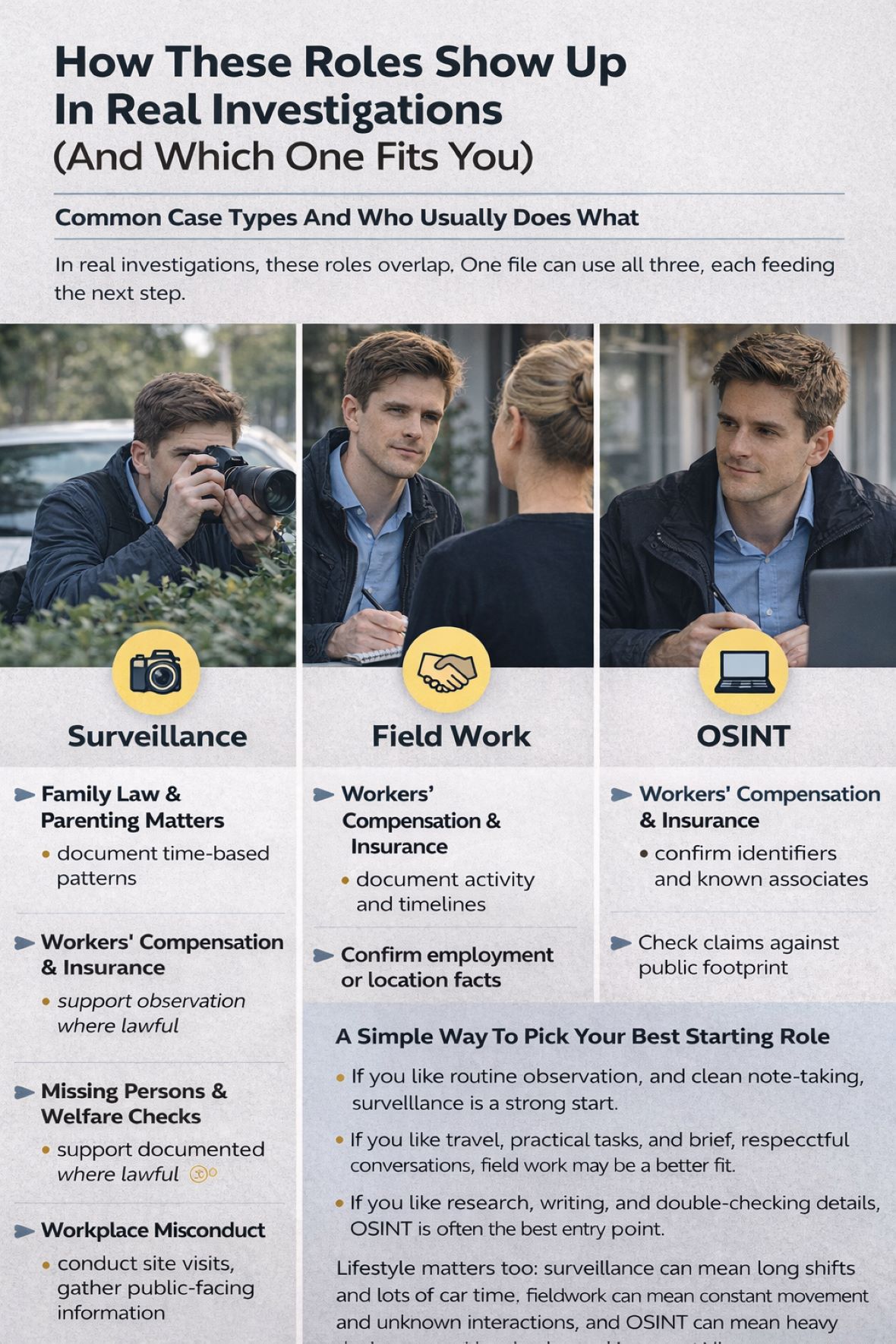
Common case types and who usually does what
In real investigations, these roles overlap. One file can use all three, each feeding the next step.
Family law and parenting matters: OSINT can help confirm identifiers and known associates. Field work can verify addresses and routines, while surveillance can document time-based patterns. Many clients begin by learning about child custody investigations.
Workers' compensation and insurance: surveillance may document activity and timelines, OSINT may check public claims against public footprint, and field agents may confirm employment or location facts through lawful checks.
Missing persons or welfare checks: OSINT can build a last-known timeline from open sources; fieldwork can confirm last-known addresses or contacts; and surveillance may support observation where lawful and appropriate.
Workplace misconduct: field agents can conduct site visits and gather public-facing information, OSINT can map business links, and surveillance may support documented observations tied to specific allegations.
A simple way to pick your best starting role
If you like routine, observation, and clean note-taking, surveillance is a strong start. If you like travel, practical tasks, and brief, respectful conversations, fieldwork may be a better fit. If you like research, writing, and double-checking details, OSINT is often the best entry point.
Lifestyle matters too: surveillance can mean long shifts and lots of car time, fieldwork can mean constant movement and unknown interactions, and OSINT can mean heavy desk time and intense focus. Many good firms rotate juniors through tasks so you can find your lane without having to guess.
Conclusion
A surveillance operative watches patiently and produces court-ready notes and footage. A field agent confirms facts on the ground, prioritising professionalism and safety. An OSINT researcher turns public information into clean leads and timelines the team can trust. Across all three, strong work stays legal, careful, and well-documented, because the smallest detail can carry the most weight later.
If you’re job hunting, pick one entry point and get excellent at it. If you’re hiring Private Investigation Services, choose a reputable team that trains, supervises, and reports with clarity.
FAQ: entry-level private investigator roles
Do I need experience to start in surveillance, field work, or OSINT?
Not always. Many people start with transferable skills and learn on the job after obtaining a license and completing role-specific training. Employers often value reliable attendance, clear writing, and calm decision-making more than a past PI title.
Is OSINT work a real PI job or just “internet searching”?
It’s real work when it’s done properly. OSINT is about verification, source tracking, and building timelines that a case team can act on. It also has firm legal and ethical limits, which are part of the skill.
What should I ask a provider before I hire Private Investigation Services?
Ask if they’re licensed for your location, who will actually work the case (junior versus senior mix), what reporting looks like and how often you’ll receive updates, how evidence and data are stored, and how costs are charged (hourly, fixed scope, or staged).
