


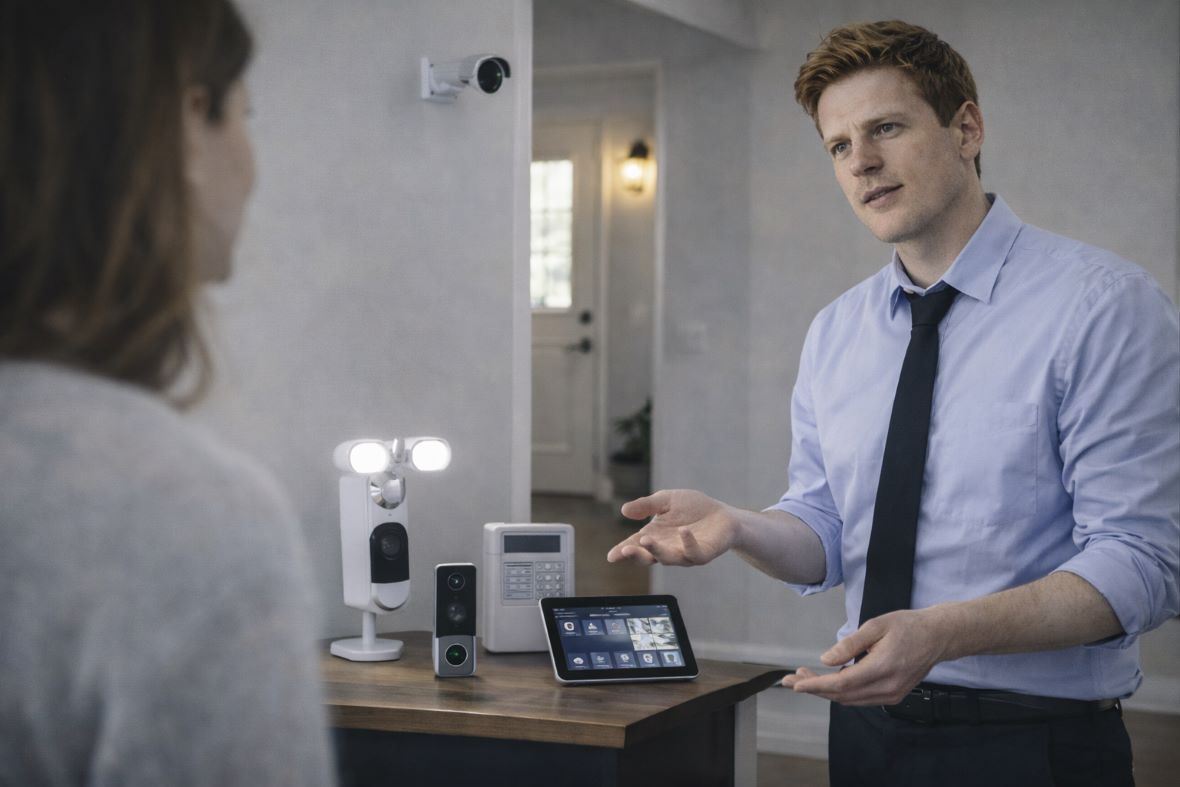
Have you ever wondered how easy it would be for a criminal to break in? Private Investigators (PIs) are trained to spot vulnerabilities in home entry points, blind spots, and routines that make a property look “easy.” Their recommendations usually aren’t about buying the most expensive gadget. They’re about building layers that increase effort, increase visibility, and reduce opportunity.
That approach lines up with established crime-prevention thinking: changing the environment (lighting, sight lines, access control) can reduce opportunities for burglary and related property crime.
What follows are the tools PIs commonly recommend, anchored in what NSW Police publish for home security and what research shows about deterrence.
Smart Cameras and Lighting That Actually Deter Burglars
A PI will usually start with visibility, because burglars prefer concealment and low-risk access. NSW Police home security guidance specifically recommends quality security lights around the perimeter and trimming landscaping that creates hiding places.
There’s also research support for lighting as a prevention tool: systematic review evidence has found that improved lighting is associated with reductions in crime, including burglary/theft-related offences, in thestudied settings.
Practical PI-style lighting rules (that match policing advice):
- Place lighting to cover paths, gates, and approaches, not just the front door.
- Reduce hiding spots: keep shrubs and trees trimmed so doors/windows aren’t “screened” from view.
- Put lights out of easy reach (tamper-resistant), and make sure there are no “dead zones.”
Camera placement: evidence matters more than having “a camera”
A common mistake is mounting cameras too high, so they only capture a hat brim. PIs often recommend:
- one camera at eye level near a gate/entry path for identification,
- and one higher- or wider-angle camera for overall coverage.
Research also supports CCTV as a modest crime prevention measure in many contexts. A meta-analysis of public-area CCTV evaluations reported an overall modest yet significant reduction in crime.
More recent systematic review work also reports CCTV is associated with a significant, modest decrease in crime, with the strongest and most consistent effects found in some settings (like car parks), while still finding reductions in other environments, including residential areas, in some studies.
So the PI logic is simple: don’t treat cameras as décor, treat them as a system that must actually capture usable detail.
| Feature | Why PIs recommend it |
| Motion sensing | Sudden light + recording increases the chance someone is seen and leaves. |
| High resolution | Helps with clearer identification when footage is used as evidence. |
| Cloud storage | Reduces the “steal the recorder” problem. |
| Two-way audio | Can deter some opportunists, but be careful with audio recording rules (see below). |
Legal note (NSW): Doorbells/cameras that capture audio can raise issues if they record private conversations. NSW surveillance device laws create offences around unlawful recording/possession/communication of records of private conversations in certain circumstances, with serious penalties.
Also, while the federal Privacy Act typically doesn’t apply to a private individual using a home security camera in a private capacity, state/territory laws may still apply, and placement matters.
Visible Cameras Versus Hidden Surveillance
You might wonder if it’s better to show off your cameras or hide them away. Most experts recommend a “layered” approach that uses both styles. A visible camera acting as a “sentinel” serves as a warning to anyone walking by. It tells them that you’re paying attention and that their face is already on a server somewhere. This alone can convince a casual thief to try a different street.
On the other hand, hidden cameras catch the people who think they’ve outsmarted your visible tech. If a burglar spots your front door camera and walks around to a side window, a hidden secondary camera will catch them off guard. This is especially helpful for internal security or for monitoring “dead zones” where a visible unit would be too easy to avoid. A mix of both ensures that you have the benefits of a visual deterrent while maintaining a backup for evidence gathering.
NEW: The “modern PI” tool most people forget — cyber-secure smart devices
If your cameras, smart doorbell, smart lock, or router are poorly secured, they can create a new kind of risk: remote access, credential theft, or someone “watching the watcher.”
Two reasons this matters in Australia right now:
- The Australian Government has introduced Smart Device Security Standards, with rules applying to many consumer smart devices manufactured on and from 4 March 2026.
- The ACSC publishes practical guidance for securing consumer IoT devices (including security cameras).
PI-style recommendations (cyber layer):
- Buy reputable devices, keep firmware up to date, and change default passwords.
- Secure the router (strong passphrase, updates) because it’s the gateway device.
- Use strong, unique passwords and protect the accounts controlling your cameras/locks
Physical Barriers That Stop Intruders in Their Tracks
Digital tools alert you. Physical security slows entry.
NSW Police guidance is very clear on the basics:
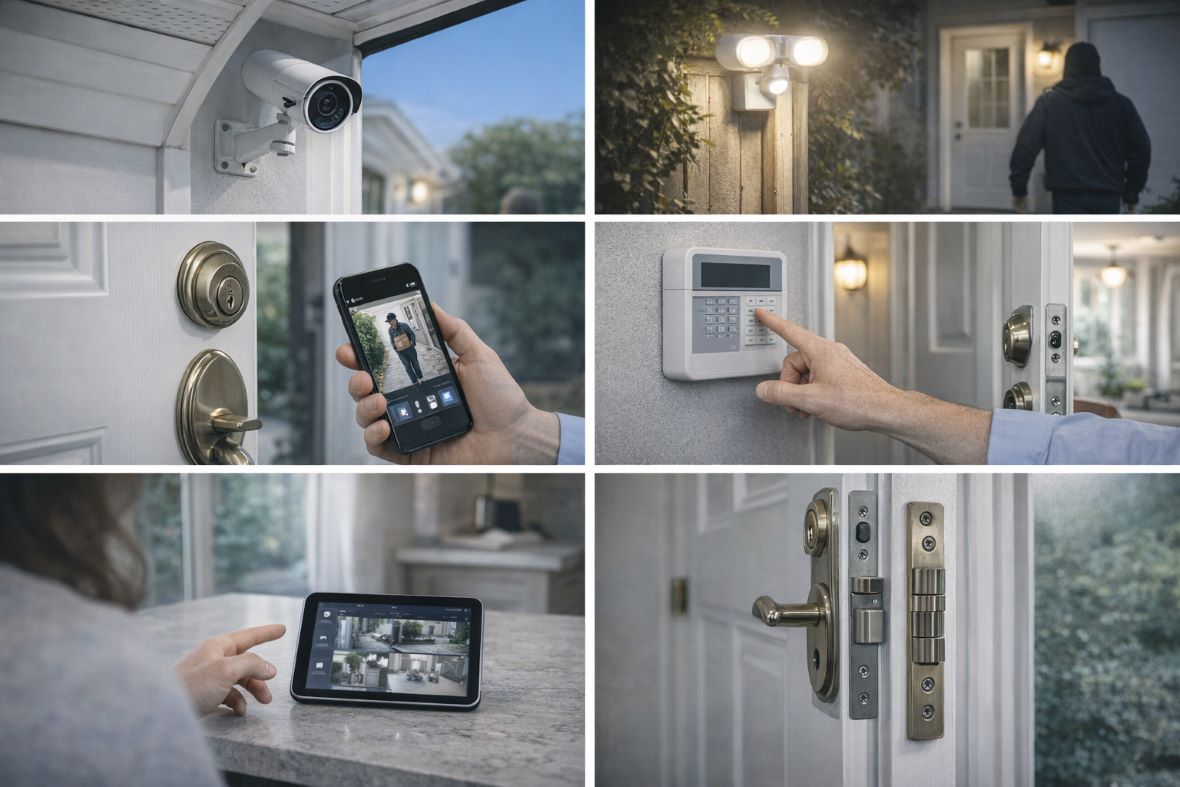
- Use solid external doors and fit quality deadlocks.
- Secure perimeter windows with key-operated locks.
- Reinforce vulnerable glass using shatter-resistant film, laminated glass, or security grilles/shutters.
This lines up with the PI view: most thieves are opportunists. If it takes longer, makes noise, or increases the chance of being seen, they’re more likely to move on.
Securing Your Perimeter and Second Story Entry Points
Many homeowners secure the front door and forget:
- gates,
- sheds,
- ladders/tools,
- and “natural staircases” like trellises and branches.
NSW Police checklists repeatedly recommend:
- keep trees/shrubs trimmed to improve visibility,
- lock gates, sheds and garages,
- and lock away tools and ladders so they can’t be used to gain access.
A PI will often walk the perimeter like a burglar would and point out, “This is the route I’d take.”
Low Tech Methods and Smart Habits Used by Professionals
Some of the most effective tools are boring, and they work because they manage signals.
NSW Police holiday guidance warns against broadcasting absence and recommends practical steps like timers, mailbox clearing, and not letting the lawn look abandoned.
PI-recommended habits that match policing advice:
- Don’t leave spare keys outside (thieves look).
- Use timers to create a “lived-in” routine when you’re out.
- Be cautious about what you post on social media while away.
- Keep a property inventory and record serial numbers/photos of valuables (useful if something is stolen).
| Common Mistake | Professional Solution |
| Leaving spare keys under mats | Use a high-quality smart lock or a hidden lockbox. |
| Advertising new purchases | Always break down boxes and hide them in trash bins. |
| Posting live travel updates | Wait until you return home to share trip photos. |
| Leaving curtains wide open | Use sheers or blinds to hide your valuables from the street. |
By managing the information you share and the appearance of your home, you reduce your profile as a target. These “soft” security measures are often just as important as the locks on your doors.
Staying One Step Ahead of the Threat
Securing your home doesn’t have to be complicated. The best private investigators in Melbourne follow layered system:
- Visibility (lighting + sight lines),
- Delay (locks, deadlocks, window security/film),
- Detection (cameras that capture usable details),
- Cyber hygiene (secure your smart devices),
- Signals (timers, mail management, low-profile behaviour).
That’s how you make your home look like work—and burglars prefer easy work.
Frequently Asked Questions
Do fake cameras work?
They may deter casual opportunists, but evidence-based prevention focuses on real measures that increase visibility and capture usable evidence.
What’s the first thing a PI checks at a house?
Usually sight lines, concealment, and easy access points—exactly the issues NSW Police highlight in their home security materials (trim shrubs, lock gates/sheds, secure doors/windows).
Are smart locks safer than traditional keys?
They can reduce risks such as hidden spare keys, but they must be secured like any IoT device: use strong passwords, keep them up to date, and secure the router/account. Australia is also moving to mandatory security standards for many consumer smart devices from 4 March 2026, reinforcing the need to choose secure products and to maintain them.
References
Australian Government, Department of Home Affairs. (2025, December 11). Security standards for smart devices. https://www.homeaffairs.gov.au/about-us/our-portfolios/cyber-security/security-standards-for-smart-devices
Australian Signals Directorate, Australian Cyber Security Centre. (2020). Tips to secure your Internet of Things device. https://www.cyber.gov.au/sites/default/files/2023-03/Tips%20to%20secure%20your%20Internet%20of%20Things%20device%20%28AUG%202020%29.pdf
Cyber.gov.au. (n.d.). How to secure your devices. https://www.cyber.gov.au/protect-yourself/securing-your-devices/how-secure-your-devices
Geason, S., & Wilson, P. R. (1989). Designing out crime: Crime prevention through environmental design. Australian Institute of Criminology. https://www.aic.gov.au/sites/default/files/2020-05/cpted.pdf
New South Wales Government. (2007). Surveillance Devices Act 2007 (NSW). NSW Legislation. https://legislation.nsw.gov.au/view/whole/html/inforce/current/act-2007-064
New South Wales Police Force. (n.d.). Residential (home safety). https://www.police.nsw.gov.au/safety_and_prevention/crime_prevention/home_safety/residential
New South Wales Police Force. (n.d.). Home Safe (PDF). https://www.police.nsw.gov.au/__data/assets/pdf_file/0020/113816/home_safe.pdf
New South Wales Police Force. (n.d.). Protect Your Home (PDF). https://www.police.nsw.gov.au/__data/assets/pdf_file/0016/820042/15811_Brochure_-_Protect_Your_Home.pdf
New South Wales Police Force. (n.d.). Protect Your Home booklet (PDF). https://www.police.nsw.gov.au/__data/assets/pdf_file/0006/779874/Protect_Your_Home_booklet.pdf
New South Wales Police Force. (n.d.). Lights, Camera, Catch ’Em: Break, enter and steal (PDF). https://www.police.nsw.gov.au/__data/assets/pdf_file/0008/862766/16648_Factsheet_-_Crime_Prevention_Break-Enter-Steal.pdf
Office of the Australian Information Commissioner. (n.d.). Security cameras. https://www.oaic.gov.au/privacy/your-privacy-rights/surveillance-and-monitoring/security-cameras
Piza, E. L., Welsh, B. C., Farrington, D. P., & Thomas, A. L. (2019). CCTV surveillance for crime prevention: A 40-year systematic review with meta-analysis. Criminology & Public Policy, 18(1), 135–159. https://doi.org/10.1111/1745-9133.12419
Welsh, B. C., & Farrington, D. P. (2008). Effects of improved street lighting on crime. Campbell Systematic Reviews, 4(1), 1–51. https://doi.org/10.4073/csr.2008.13
Welsh, B. C., & Farrington, D. P. (2009). Public area CCTV and crime prevention: An updated systematic review and meta-analysis. Justice Quarterly, 26(4), 716–745. https://doi.org/10.1080/07418820802506206
