


Last updated:
Social media has turned everyday posts, photos, and check-ins into powerful clues that private investigators can use to uncover the truth faster than ever before. This article explains how social platforms help private investigation to move quickly, why they also create serious legal and ethical risks, and why skilled professional judgment matters more than simply “looking someone up online.”
The way people live today changed the moment social media became the primary way we talk, share, and track our lives, making it a crucial tool for private investigators. You can post photos of your holidays, share major life events, and check in at places without a second thought. This public sharing creates a detailed digital footprint for everyone. In the field of private investigation, this shift presents an extraordinary opportunity, but it also carries significant risks. Social platforms are essential tools for getting quick answers, but they are also traps filled with lies and legal dangers. You need to understand this double-edged role. This article explores both the incredible advantages and the real pitfalls of social media, helping you see why hiring a skilled private investigation professional is more critical than ever.
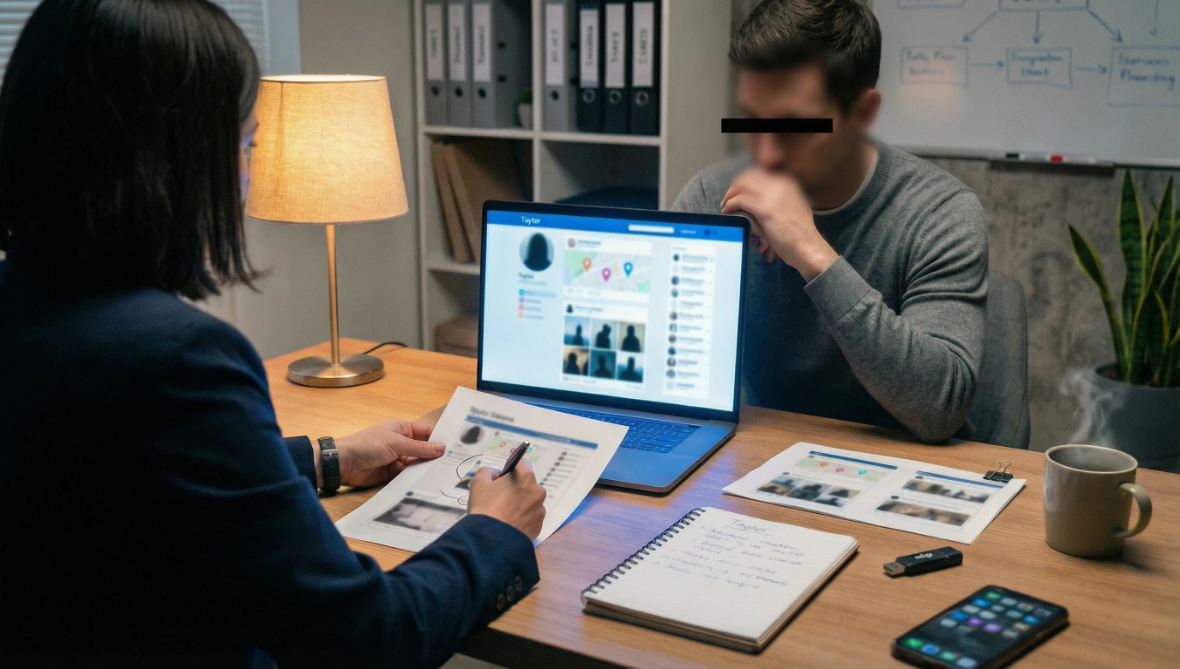
How Private Investigation Use Social Media for Powerful Evidence
Social media platforms are treasure troves of easily accessible, public information. Think of the sheer volume of data available; people willingly post details about their jobs, relationships, hobbies, and even their current location. For example, a private investigator can find a missing person by analyzing recent posts or tagged locations. This is a significant benefit for private investigators seeking to generate leads and quickly find supporting evidence. The information is often current and, most importantly, posted directly by the subjects themselves. This self-generated data can significantly reduce the time spent on traditional surveillance work.
Finding Key People and Locating Witnesses Fast
Finding someone used to mean sorting through paper records or knocking on countless doors. Now, social media has created shortcuts. Platforms like Facebook, Instagram, and LinkedIn are excellent starting points for a professional private investigator. They use these sites to locate missing persons, find crucial witnesses for ongoing legal cases, or confirm a person’s current location and employment status.
For instance, if you need to find a witness who saw a car accident, a search of local groups or tagged photos can often lead directly to that person. This speed is a huge advantage. You save time and money when the investigator can quickly verify where someone works or lives, information that is essential for progressing an investigation.
Gathering Open-Source Proof for Legal Cases
Social media provides concrete, date-stamped evidence you can’t ignore, helping private investigators build trust in their findings and reassuring clients of their reliability. When a subject posts frequent life updates, they are creating a timeline of their actions. Posts, photos, comments, and digital check-ins (geotags) serve as powerful, factual data points.
Consider a case involving a fraudulent disability claim. If the subject claims they cannot perform strenuous physical tasks, but their Instagram profile is filled with recent photos of them completing marathons or lifting heavy weights, you have indisputable proof. Similarly, in divorce cases, public activity posts can confirm a spouse’s association or activity, giving you greater investigative accuracy. This open-source proof is powerful because it shows the subject’s own words and actions, often contradicting their official statements. A professional private investigator knows how to capture and preserve this information correctly so it is admissible in court.

The Hidden Dangers: Why Social Media Can Harm a Private Investigation
While social media offers significant advantages, it is truly a double-edged tool. It introduces serious challenges and risks that can complicate and even ruin a case, making private investigators feel more secure when they understand how to navigate these dangers carefully. The ease of access to information is offset by the dangers of fake profiles, misinformation, and complex legal and ethical restraints. These issues make the job of private investigators far harder and legally risky if they are not careful.
Identifying and Avoiding Fake Profiles and Misinformation
Not everything you read online is true; this sounds obvious, but you must remember it when dealing with investigative work. Subjects know they might be watched, and some intentionally create fake profiles or post old, misleading information to confuse people. They might post photos from five years ago to establish a false timeline or use an alias to hide their real activities.
A skilled private investigator must be diligent in spotting these traps. If a profile has very few friends, generic photos, or inconsistent posting habits, it raises questions about its authenticity. Relying on misinformation introduces false leads, wastes valuable time, and, most critically, destroys investigative accuracy. You must ensure the information traces back directly to the actual subject, not a deceptive imitation.
The Gray Area of Privacy Laws and Ethical Boundaries
This is the most significant danger inherent in digital investigation. The law has not kept pace with the speed of online activity, creating significant gray areas, particularly regarding privacy. Private investigation professionals must know precisely where the legal lines are drawn and must never cross them.
For example, ‘pretexting,’ the creation of a fake identity or false persona to gain access to a person’s private information, can lead to serious legal trouble. An investigator cannot pretend to be someone else to friend a subject and view password-protected content. Federal laws, such as the Computer Fraud and Abuse Act (CFAA), strictly forbid unauthorized access to protected computer data. Ignoring these laws can cause courts to reject evidence and, in serious cases, expose a private investigator to criminal charges. Professional investigators access only publicly shared information, acting with integrity and strict legal compliance to protect trust and credibility.

Innovative Strategies for Private Investigators in the Digital Age
To address both the high speed and the inherent risks of social media, private investigators need clear, innovative strategies. If you are hiring an investigator, you want assurance that they are following current best practices and adapting to the constantly shifting rules of online platforms.
Verifying Digital Evidence to Ensure it Holds Up in Court
Collecting evidence is only half the work; presenting it effectively in a courtroom is the other. The defense will always try to argue that digital evidence was altered, faked, or improperly collected. Therefore, proper documentation and verification are non-negotiable standards for a professional private investigator.
Investigators must collect evidence in a forensically sound way that proves its originality and chain of custody. This process involves several critical steps:
- Certified Capture Tools: Using software specifically designed to capture social media content, ensuring all necessary metadata (like date, time, and URL) is recorded.
- Timestamping: Documenting when the content was viewed and saved.
- Authentication: Clearly linking the obtained profile or post directly to the subject of the investigation, often by cross-referencing details only that person would know.
Without this careful approach, even the most damaging picture or post is essentially worthless. This diligence is what separates a credible private investigation from speculative guessing.
Balancing Digital Clues with Old-School Detective Work
You should remember that social media offers clues, not complete final answers. The strongest, most reliable private investigation relies on combining digital footprints with traditional methods. Digital leads must always be confirmed through physical surveillance, interviews, and searches of public and government records.
For example, a Facebook check-in might show a subject at a restaurant in another city. A good investigator doesn’t stop there; they use that location as a starting point for physical surveillance to confirm the subject’s presence and activities in person. This approach maximizes investigative accuracy. Physical confirmation grounds the digital evidence in reality, making the final report much more robust and trustworthy. Relying solely on digital data ignores the subject’s ability to manipulate their online appearance.
If you are looking for an investigator, look for one who treats social media as a component, not the entire solution. The balance between looking at a screen and watching the street is what generates results that truly matter. Investigators must continually train to keep up with rule changes on platforms like TikTok and X (formerly Twitter). The methods used last year may not be compliant or effective today.
| Investigative Method | Primary Advantage | Associated Risk |
| Social Media Monitoring | Speed, access to self-generated data, instant leads. | Misinformation, ethical violations, and privacy laws. |
| Physical Surveillance | Verified, conclusive, court-admissible visual proof. | Time-consuming, expensive, and requires specialized skill. |
| Public Records Search | Government-certified facts (e.g., property, arrests). | Can be outdated, requires professional data access. |
You need professionals who can effectively manage this mix of tools. They must know when to stop clicking and start watching, ensuring every action complies with the law. They understand the difference between public opinion and legal evidence.
Social media will continue to change how investigations are conducted. It provides immediate, robust evidence that once took weeks or months to obtain. However, this speed and volume of data also bring significant legal and ethical overhead. The enduring value of a skilled private investigator lies not just in their ability to find this digital evidence, but in their capacity to use it wisely, ensuring high investigative accuracy while operating strictly within the confines of the law. Social media is now a permanent, necessary part of modern detective work, demanding a blend of technical know-how and traditional caution from those you hire.

Written by Rob Jones, Senior Investigator at Magnum Investigations. Rob works on surveillance, locate and background check cases for clients in Melbourne and across Australia.
GORA Investigations Pty Ltd, NSW Master Licence 412080174.
